LGTM Is Not a Theorem
Refunds. Tuesday.
capture → settlement is T+1. Today we only refund what has settled.
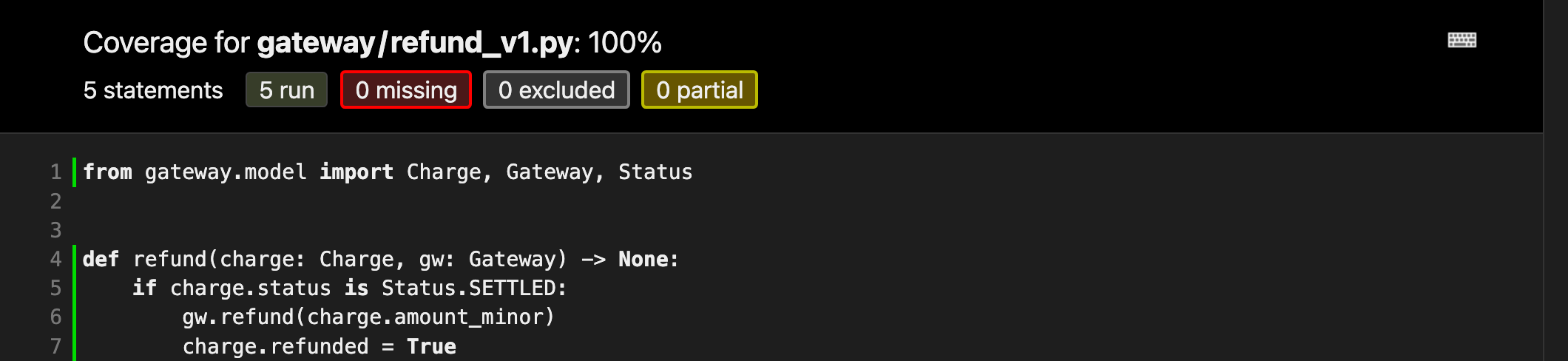
Wednesday: the same-day cancellation
Settlement lags capture by a day, so a customer who cancels that afternoon is CAPTURED, not SETTLED, and support cannot refund them.
    if charge.status is Status.SETTLED:
        gw.refund(charge.amount_minor)
        charge.refunded = True
    elif charge.status is Status.CAPTURED:      # the ticket
        gw.refund(charge.amount_minor)
        charge.refunded = True
Copy the test. Change one word.
def test_refunds_a_settled_charge():
    c = Charge(1, Status.SETTLED, 24900)
    gw = Gateway()
    refund(c, gw)
    assert gw.refunds == [24900]
def test_refunds_a_captured_charge():
    c = Charge(3, Status.CAPTURED, 24900)
    gw = Gateway()
    refund(c, gw)
    assert gw.refunds == [24900]
Nine seconds of work. The build is green. Ship it.
Thursday, 02:14. Sev-2.
The gateway call for a refund times out. The job
retries it. Nothing in refund()
remembers that the first one already went through.
refund(charge 3) gw.refund(24900) ok timeout
refund(charge 3) gw.refund(24900) ok ← retry
gw.refunds: [24900, 24900] refunded twice
We are losing money. Patch it tonight.
So you patch it
def refund(charge, gw) -> None:
    if charge.refunded:      # the patch
        return
    if charge.status in REFUNDABLE:
        gw.refund(charge.amount_minor)
        charge.refunded = True
def test_refunding_twice_refunds_once():
    c = Charge(4, Status.SETTLED, 24900)
    gw = Gateway()
    refund(c, gw)
    refund(c, gw)
    assert gw.refunds == [24900]
Idempotent now. Incident closed. Properly fixed.
More testing… more testing… more testing…
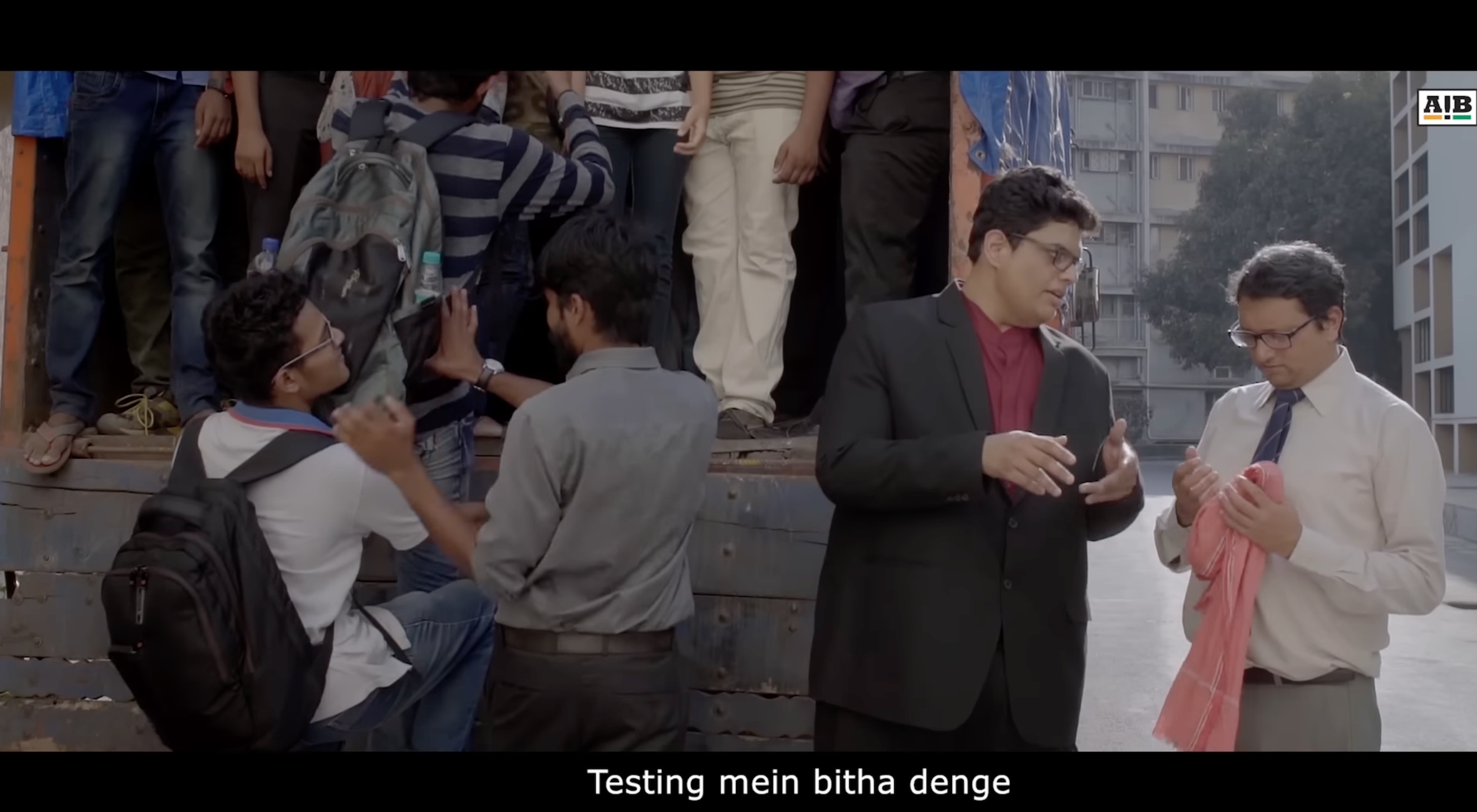
Testing will not catch this one.
Two ways in. The same broken state.
| who | step | (r, p) |
|---|---|---|
| A | read flag → false | (false, 0) |
| A | gw.refund() | (false, 1) |
| A | 504, exception | raises |
| A | refunded = True | never runs |
| retry | read flag → false | (false, 1) |
| retry | gw.refund() | (false, 2) |
| who | step | (r, p) |
|---|---|---|
| A | read flag → false | (false, 0) |
| B | read flag → false | (false, 0) |
| A | gw.refund() | (false, 1) |
| B | gw.refund() | (false, 2) |
| A | refunded = True | (true, 2) |
| B | refunded = True | (true, 2) |
Both pass through
(false, 1), money gone, flag still down.
The guard reads the flag, so it waves both of them through.
Then stop guessing the schedule
A test has to pick an interleaving, and there are exponentially many. So pick none. Instead prove that every single step keeps one sentence true.
If it holds at the start, and no step can break it, it holds in every reachable state, under every interleaving, including the ones you never thought of.
A trace you found. An obligation you cannot discharge.
step t₂ : p += 1 (gw.refund returns)
show Agree(false, 1)
1 ≤ 1 ✓
r = false ⇒ p = 0 becomes 1 = 0 ✗ unprovable
The goal itself hands you the bug, and every other route to it you never imagined.
The same step, written twice
def cas (s : St) : St :=
  if s.refunded then s
  else ⟨true, s.payouts + 1⟩

theorem cas_preserves :
  Agree s → Agree (cas s)

theorem cas_safe (n : Nat) :
  Safe (run n ⟨false, 0⟩)
claimed = (Charge.objects
    .filter(id=cid, refunded=False)
    .update(refunded=True))

if claimed == 0:
    raise AlreadyRefunded

gw.refund(charge.amount_minor)
One SQL statement is one atomic step, so the model
has one too. Read the flag and write it in the same move, and
(false, 1) stops being reachable,
for any number of workers, in any order.
So why don’t we prove everything?
If the mathematics is this good, why are any of us still writing tests?
Well… because…
If it goes through, it is a proof
And if the proof goes through on your machine, it is a proof. Not probably. Not mostly. The checker does not care who wrote it, or whether they understood it.
That is not true of generated code.
The curve moved
The steep part used to be producing the proof. That is what took years to learn, and it is the part you now hand over.
What is left is different.
reading the statement
deciding whether it is enough
The skill is not writing the proof. *
* at scale, proof size and token cost matter again. This is about the first step.
You have shipped this a hundred times
| rfnd_8821 | acc_42 | 249.00 | settled |
| rfnd_8822 | acc_17 | 899.00 | settled |
| rfnd_8823 | acc_91 | 120.00 | settled |
| rfnd_8824 | acc_08 | 1,499.00 | settled |
| rfnd_8825 | acc_63 | 75.00 | settled |
Twenty-three rows, five to a page. Something has to decide which rows land on which page, and that something is a handful of lines in Django.
A very small chunk of Django
The code that decides which rows land on which page, and the suite that covers it.
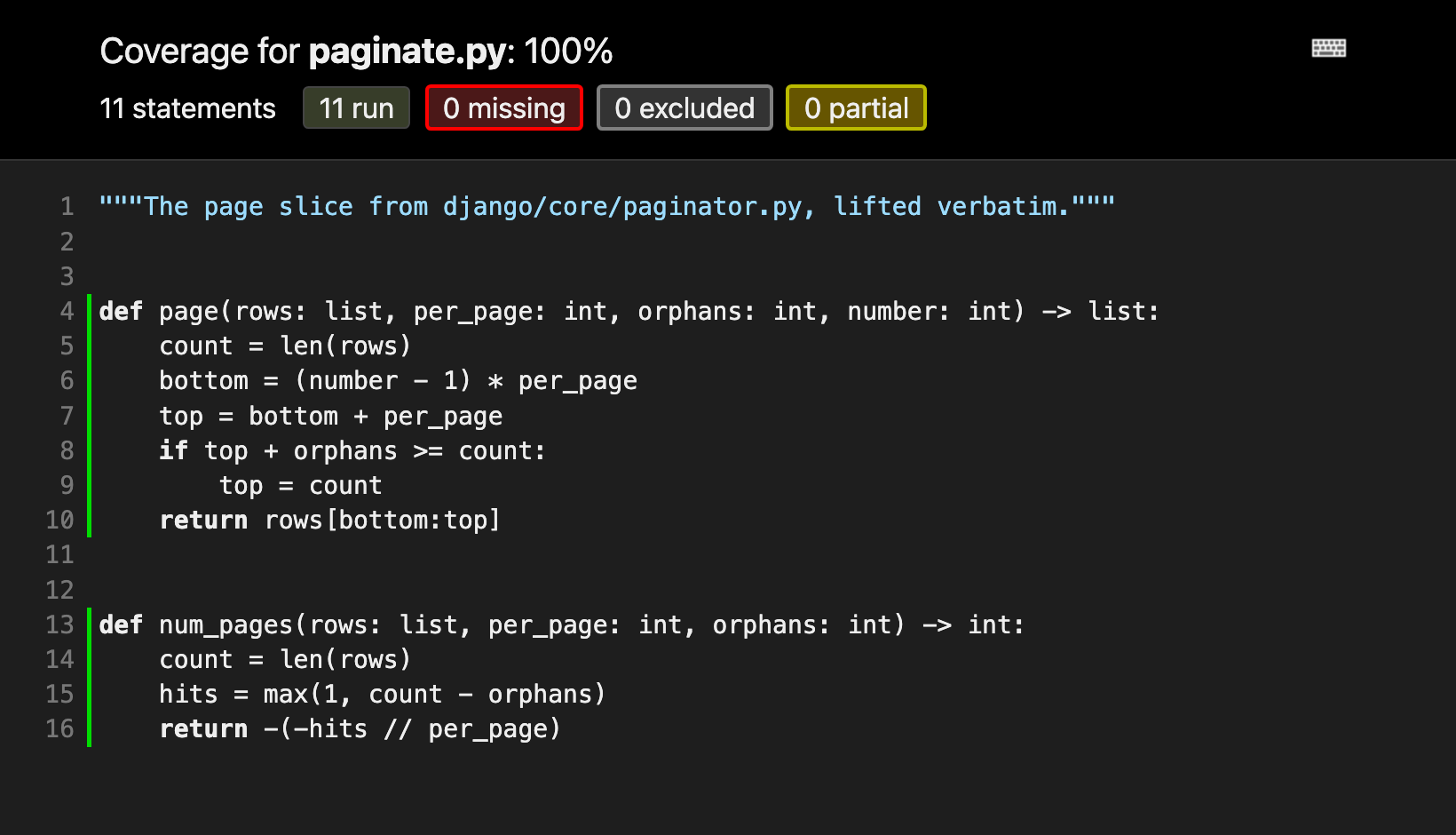
It is arithmetic. What could go wrong?
Fair. I mutated those lines nine ways: off-by-ones,
flipped comparisons, a dropped orphans.
Every one was caught. The suite is good.
Then I read the rest of the file:
if self.per_page <= self.orphans:
    # RemovedInDjango70Warning: ... replace with:
    # raise ValueError(
    #     "The orphans argument cannot be larger than or "
    #     "equal to the per_page argument."
    # )
Django shipped that for years before anyone wrote the precondition down.
One line, and what it buys
Paginator(rows, per_page=2, orphans=20)

  22 rows → 1 page of 22
Paginator(rows, per_page=2, orphans=20)

  ValueError: orphans cannot be larger
  than or equal to per_page
theorem page_bounded (hk : 0 < k) (ho : o < k) (l : List α) :
  ∀ p ∈ pages k o hk l, p.length < 2 * k
Build completed successfully
error: omega could not prove the goal
a possible counterexample may satisfy
a ≥ 1 a + b - c ≥ 0 2*a - c ≤ 0
where a := k b := o c := p.length
I am not asking you to prove everything
A gateway that retries. A client that parses your JSON. A queue that delivers twice. That is where the contract lives, and it is small.
And you do not have to start with a proof
Every property on the last few slides can be checked without proving anything at all.
@given(st.lists(st.integers()), st.integers(min_value=1))
def test_pages_partition(rows, per_page):
    assert flatten(paginate(rows, per_page)) == rows
They make you write the contract down. They do not make you discharge it. Most of the value, a fraction of the price, and you can do it this afternoon.
And it is not a silver bullet
A proof guarantees one thing: the code matches the spec.
All I am saying is that the price moved, and the economics are now on your side.
Thank you
LGTM is a vote. A theorem is a receipt.
- durwasa.chakraborty@gmail.com preferred
- blog
- durwasa-chakraborty.github.io
- github
- github.com/durwasa-chakraborty
- bluesky
- durwasa.bsky.social
- in/durwasa-chakraborty
Special thanks to
Anirudh Gupta, IISc Bangalore for the initial idea of verifying
across boundaries and
Prof. KC Sivaramakrishnan and Prof. Kartik Nagar for … well
everything about Formal Verification.
Every tool in this talk is free software. Python · coverage.py · Hypothesis · Lean 4 · Django